Historical Museum of Crete | Discover 17 centuries of Cretan history
SHARE IT
Welcome to the Historical Museum of Crete!
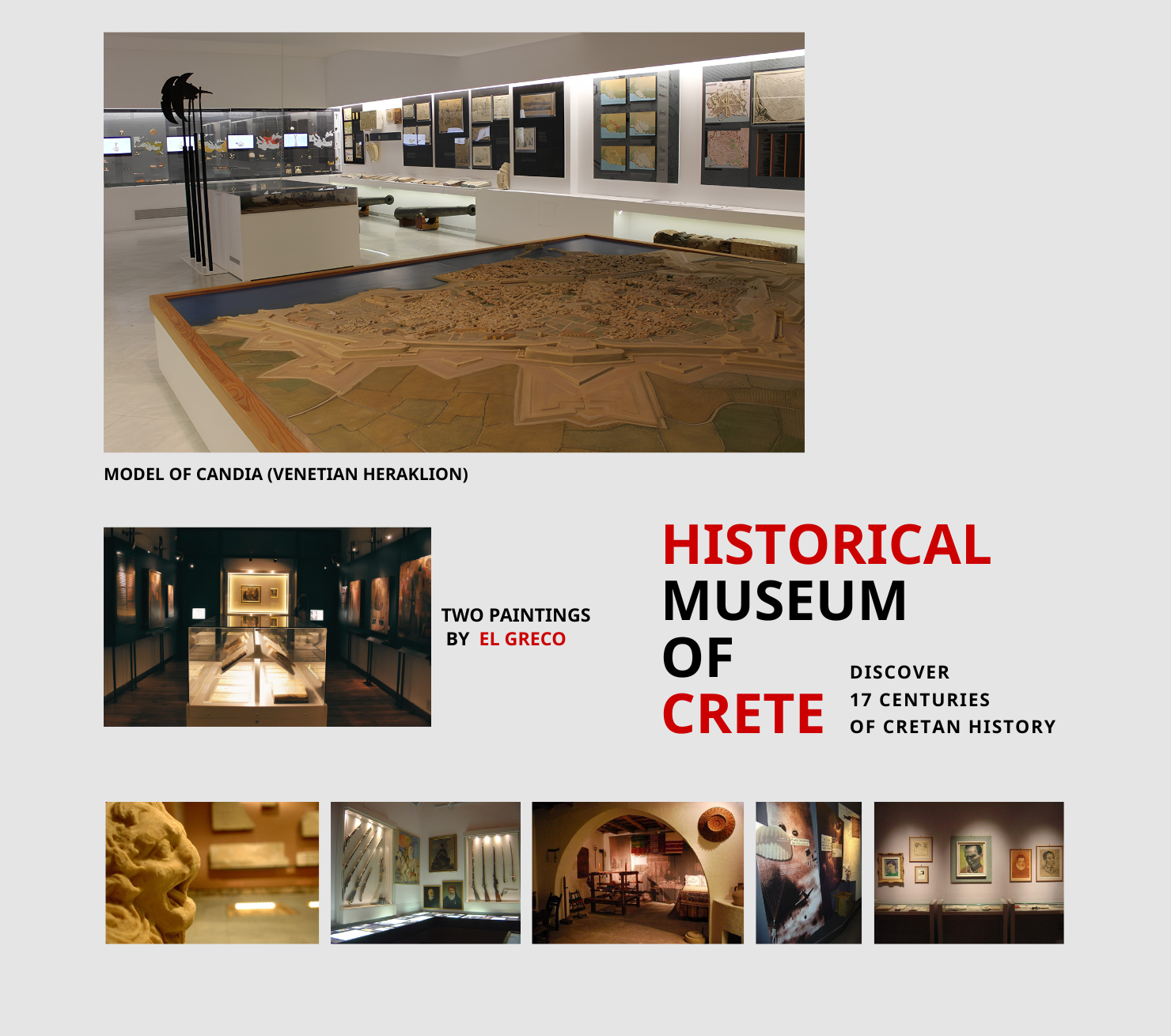
Discover the rich history and cultural heritage of Crete from the early Christian era to the modern age. Through unique collections, interactive exhibits, and rare masterpieces, the Historical Museum of Crete offers an unforgettable journey through time.
How to get here
Opening Hours
- Summer Season (May - October): Monday - Sunday 09:00 - 17:00
- Winter Season (November - April): Monday - Friday 09:00 - 15:30, Saturday 09:00 - 15:00, Closed on Sundays and Public Holidays
Admission Fees
- General Admission: €8.00
- Concessions (Students, Seniors 65+): €5.00
- Children 12 and under: Free entry
Services & Accessibility
- Audio Guides: Available in multiple languages with an additional fee (English, German, French, Russian, Greek).
- Museum Shop: Find unique souvenirs, high-quality replicas, and a wide selection of books on Cretan history.
- Museum Café: Relax in a beautiful courtyard garden and on a deck overlooking the sea, enjoying refreshments and snacks.
- Accessibility: Fully accessible for people with reduced mobility.
Location & Contact
📍 Address: Sofokli Venizelou 27, Heraklion | 📞 Tel.: +30 2810 283219 | 🌐 Website: www.historical-museum.gr
ΙΣΤΟΡΙΚΟ ΜΟΥΣΕΙΟ ΚΡΗΤΗΣ
Το Ιστορικό Μουσείο Κρήτης ιδρύθηκε το 1953 και στεγάζεται σε νεοκλασικό οίκημα ιδιαίτερης αρχιτεκτονικής αξίας. Αφηγείται δεκαεπτά αιώνες τοπικής ιστορίας και πολιτισμού, από τους πρώτους χριστιανικούς αιώνες ως τη σύγχρονη εποχή. Η Βυζαντινή τέχνη και ο πολιτισμός, η περίοδος της Βενετσιάνικης και της Οθωμανικής κυριαρχίας, η εποχή των επαναστάσεων στην πορεία προς την Ένωση με την Ελλάδα, ο Β΄ Παγκόσμιος Πόλεμος, η Μάχη της Κρήτης και η Αντίσταση, αλλά και ο λαϊκός πολιτισμός της κρητικής υπαίθρου, προβάλλονται μέσω επιλεγμένων εκθεμάτων σε συνδυασμό με πλούσιο εποπτικό υλικό και πολυμέσα.
Κορυφαία εκθέματα αποτελούν οι πίνακες του El Greco, «Η Βάπτιση του Χριστού» (1569) και «Άποψη του Όρους και της Μονής Σινά» (1570), τα μοναδικά έργα του που εκτίθενται στην Κρήτη. Σε ιδιαίτερη ενότητα, η Συλλογή Νίκου Καζαντζάκη περιλαμβάνει προσωπικά αντικείμενα και χειρόγραφα του κρητικού συγγραφέα. Ξεχωριστό έκθεμα στην αρχή της επίσκεψης αποτελεί το μεγάλο ομοίωμα της πόλης του Χάνδακα (Ηράκλειο) των μέσων του 17ου αιώνα.
HISTORICAL MUSEUM OF CRETE
The Historical Museum of Crete was founded in 1953 and is housed in a neoclassical building of exceptional architectural merit. It tells the story of seventeen centuries of local history and culture, from the early Christian centuries up to modern times. Byzantine art and culture, the periods of Venetian and Ottoman rule, the age of revolutions on the path to union with Greece, World War II, the Battle of Crete and the Resistance, as well as Cretan rural folk culture are all highlighted via selected exhibits combined with a wealth of visual material and multimedia.
Among the Museum's highlights are two El Greco paintings, "The Baptism of Christ" (1569) and "View of Mt. Sinai and the Monastery of St. Catherine" (1570), the only works by the artist in Crete. The Nikos Kazantzakis Collection is in a special section including personal items and manuscripts by the Cretan writer. Visits begin in the introductory room of the Museum featuring a large-scale model of mid-17th century Chandax (Heraklion).
MUSÉE HISTORIQUE DE CRÈTE
Le Musée Historique de Crète, installé dans un bâtiment néoclassique de grande qualité architecturale, a été fondé en 1953. Il raconte dix-sept siècles d'histoire et de culture crétoises, des premiers temps de l'ère chrétienne jusqu'à nos jours. Art et civilisation byzantine, souveraineté vénitienne, occupation ottomane, époque des nombreuses révolutions au cours de la longue marche vers le rattachement à la Grèce, Deuxième Guerre mondiale, Bataille de Crète, Résistance, et, finalement, art et culture populaires dans la Crète rurale, sont présentés au visiteur grâce à une profusion de collections et d'objets choisis avec soin, qu'accompagne un abondant matériel documentaire traditionnel et multimédia.
Parmi les joyaux du Musée on compte les deux tableaux du Greco, "Le Baptême du Christ" (1569) et la "Vue du Mont Sinaï et du Monastère de Sainte Catherine" (1570), qui sont les seules œuvres de l'artiste conservées en Crète. Une section particulière est consacrée à Nikos Kazantzakis : elle rassemble des objets personnels et des manuscrits du célèbre écrivain crétois. La grande maquette de la ville de Chandax (Héraklion), qui date du 17e siècle, constitue un des éléments remarquables du début de la visite.
HISTORISCHES MUSEUM VON KRETA
Das Historische Museum von Kreta wurde 1953 gegründet und ist seitdem in einem neoklassischen und architektonisch sehr wertvollen Gebäude untergebracht. Erzählt wird hier von siebzehn Jahrhunderten lokaler Geschichte und Kultur, von den ersten christlichen Jahrhunderten bis hin in die moderne Zeit. Die byzantinische Kunst und Kultur, die venezianische und osmanische Herrschaft, die Zeit der Revolutionen auf dem Weg zur Vereinigung Kretas mit Griechenland, der Zweite Weltkrieg, die Schlacht um Kreta und die Widerstandsbewegung, sowie die Volkskultur der kretischen Landbevölkerung werden dabei anhand von ausgewählten Objekten und in Verbindung mit umfangreichem audiovisuellem Material und multimedialen Anwendungen präsentiert.
Den Höhepunkt der Ausstellung bilden El Grecos Werke "Taufe Christi" (1569) und "Ansicht des Bergs Sinai und des Katharinenklosters" (1570), die einzigen seiner Werke, die sich auf Kreta befinden. Die in einer gesonderten Abteilung befindliche Sammlung Nikos Kazantzakis umfasst persönliche Gegenstände und Manuskripte des kretischen Schriftstellers. Ein Ausstellungsstück von besonderer Bedeutung ist bereits beim Start des Museumsrundgangs zu bewundern: das Modell von Chandakas (Heraklion), welches das Bild der Stadt Mitte des 17. Jahrhunderts vermittelt.
MUSEO STORICO DI CRETA
Il Museo Storico di Creta fu fondato nel 1953, ed è ospitato in un edificio neoclassico di eccezionale pregio architettonico. Narra diciassette secoli di storia e cultura locale, ovvero dalla prima epoca cristiana sino ai tempi moderni. L'arte e la cultura bizantina, la dominazione veneziana ed ottomana, l'età delle rivoluzioni per l'unificazione con la Grecia, la Seconda Guerra Mondiale, la Battaglia di Creta e la Resistenza, nonché la cultura popolare rurale cretese sono evidenziate attraverso reperti selezionati, accompagnati da una grande quantità di materiale visivo e multimediale.
Le opere più importanti ed ammirate sono due dipinti di El Greco, "Il Battesimo di Cristo" (1569) e "Veduta del Monte Sinai e del Monastère de Sainte Catherine" (1570), le uniche opere dell'artista conservate a Creta. Inoltre, la Collezione Nikos Kazantzakis, in una sezione speciale, ospita gli effetti personali ed i manoscritti dello scrittore cretese. La visita inizia in una sezione separata, dove si può ammirare un grande plastico della città di Chandax (Heraklion) alla metà del XVII secolo.
КРИТСКИЙ ИСТОРИЧЕСКИЙ МУЗЕЙ
Критский исторический музей был основан в 1953 году. Он располагается в неоклассическом особняке, представляющем собой выдающийся памятник архитектуры. Экспозиция музея охватывает семнадцать столетий истории и культуры острова: от первых веков христианства до наших дней. Искусство и культура византийской эпохи, периоды венецианского и османского владычества, эпоха революций и борьба за объединение с Грецией, Вторая мировая война, битва за Крит и сопротивление, а также традиционная культура критской деревни представлены тщательно подобранными экспонатами в сочетании с богатым наглядным и мультимедийным материалом.
В число сокровищ музея входят картины Эль Греко «Крещение Христа» (1569) и «Вид на гору Синай и монастырь Святой Екатерины» (1570) – единственные работы художника, находящиеся на Крите. В особом зале, посвященном Никосу Казандзакису, выставлены личные вещи и рукописи критского писателя. Осмотр экспозиции музея открывает особый экспонат – большой макет города Хандакс (Ираклион) в том виде, каким он был в середине XVII века.